
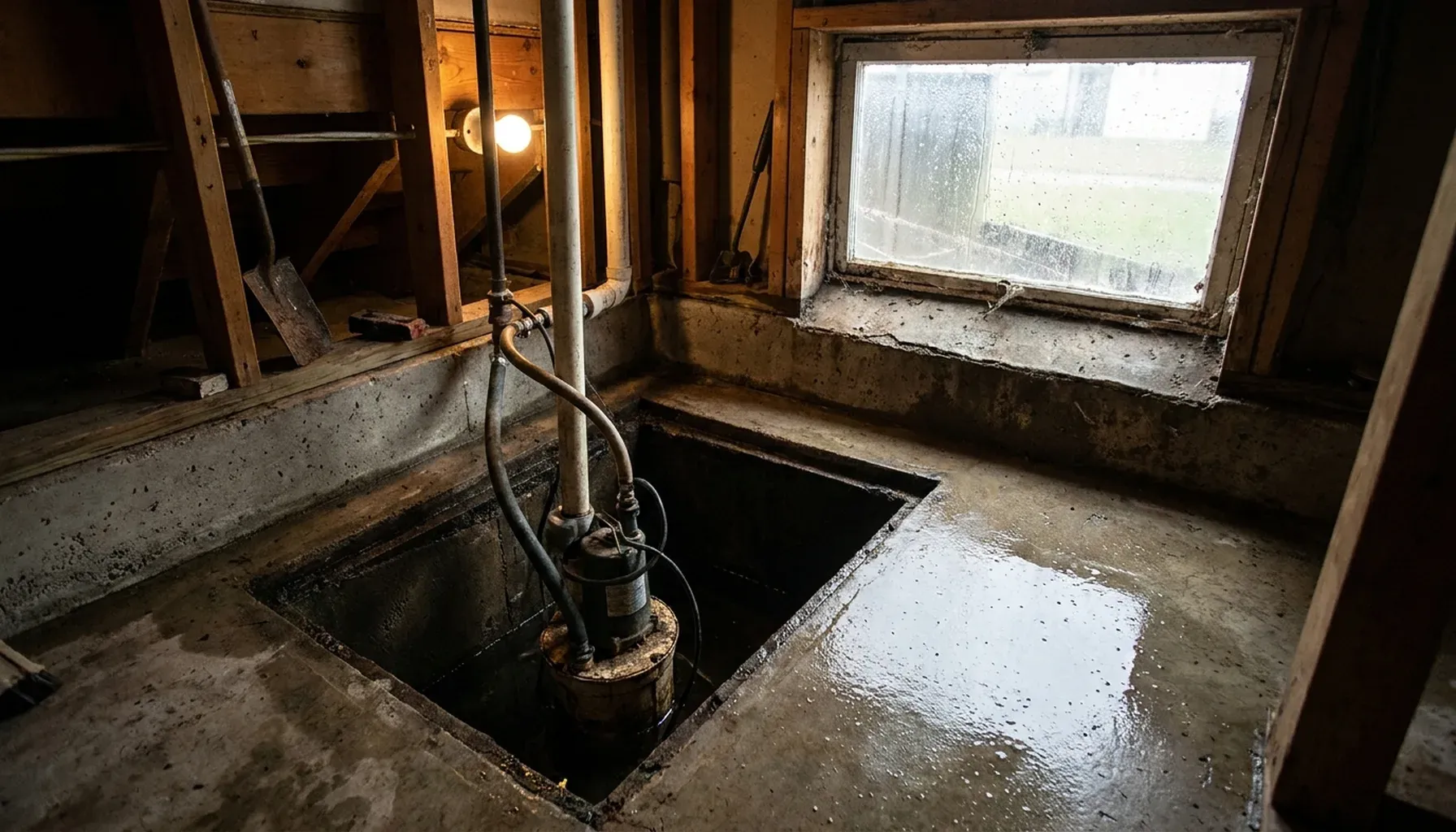
Ask anyone who has owned a home near the lake for more than a few years: spring is when basements in Waukegan get wet. The pattern repeats almost every year — the ground thaws, the rain arrives in heavy bursts, and by late April the calls about wet carpet, tripped sump pumps, and backed-up floor drains start stacking up across Lake County.
None of it is random. Waukegan basements flood for reasons you can see coming, and most of them can be managed before the water shows up. Here is what is actually happening under your house, and what to do about it.
The Three Reasons Spring Hits Waukegan Basements Hardest
1. Saturated Clay Soil Has Nowhere to Send the Water
Much of Lake County sits on dense, clay-heavy soil that drains slowly. After snowmelt, the ground around your foundation is already holding close to its capacity — so when a spring storm drops an inch or two of rain in an afternoon, that water does not soak away. It builds up against your foundation walls and floor, creating hydrostatic pressure that forces moisture through any path it can find: foundation cracks, the cove joint where wall meets floor, window wells, and floor drains.
2. Older Homes, Older Drainage
Waukegan's housing stock is one of the oldest in the county — thousands of homes here were built before 1960, and many near the lakefront and the older south-side neighborhoods date back much further. Homes of that era were often built with clay drain tile, undersized sump pits, or no dedicated sump system at all. Decades later, original drain tile has silted up or collapsed in many of these houses, which means water that should be routed to the pit ends up on your floor instead. If your home is pre-1960 and you have never had the perimeter drainage evaluated, spring is the season that will find its weak points. Nearby communities see their own versions of the same story — Gurnee's neighborhoods along the Des Plaines River have a well-documented flood history, with major events in 1986, 2008, and 2017.
3. The Storm That Floods Your Basement Also Kills Your Power
Basement flooding in this area clusters around big storm systems, and those same storms take down power lines. A primary sump pump — the thing standing between your basement and the water table — runs on the electricity that just went out. That is why so many flooded basements happen during an outage: the pit fills, the pump sits silent, and the water follows gravity into the finished space. It is also why a sump pump setup without battery backup is only half a system in Lake County.
A Spring Sump Pump Checklist That Takes 15 Minutes
You do not need special tools for any of this:
- Test the pump. Pour a five-gallon bucket of water into the pit. The pump should start within seconds, empty the pit quickly, and shut off cleanly. No start, slow drain, or nonstop running all mean it needs attention.
- Check the float. The float switch is the most common failure point. Make sure it moves freely and is not wedged against the pit wall or tangled in the discharge line.
- Look at the discharge line outside. It should carry water several feet away from the foundation and be clear of debris. A discharge that dumps right at the wall just recycles the same water back into your pit.
- Listen. Grinding, rattling, or constant humming are signs of a motor or impeller on its way out. A pump that sounds wrong in May usually fails in the first big June storm.
- Check the age. Most residential pumps last 7–10 years. If yours is older — or you have no idea how old it is — plan its replacement on your schedule instead of the storm's.
- Consider backup power. A battery backup pump takes over automatically when the power drops. For a finished basement, it is some of the cheapest insurance you can buy.
Floor Drain Backing Up? That Is a Different Problem
Not all spring water comes through the walls. If water is coming up through a floor drain — especially with an odor — you are looking at a drain or sewer problem, not a groundwater problem. Heavy rain can overwhelm older combined lines, and tree roots that grew into sewer laterals all winter make a partial blockage into a full one exactly when flow peaks. That situation calls for drain cleaning or sewer rodding rather than a bigger sump pump, and a camera inspection will tell you which.
When to Stop Reading and Call
If water is actively entering your basement, treat it as the emergency it is: keep clear of standing water near outlets or appliances, cut power to the basement at the breaker if you can reach it safely, and call a plumber in Waukegan right away. An emergency plumber visit while the water is rising is almost always cheaper than the flooring, drywall, and mold remediation that follow a night of standing water.
And if this spring passed without incident? That is the best time to do the checklist above — the pumps that fail in June are the ones nobody tested in May.
Need a plumber?
Frequently Asked Questions
Why does my basement flood every spring in Waukegan?
Spring combines the three things basements hate most - saturated ground from snowmelt, heavy rain in short bursts, and a water table that has nowhere to drain. In much of Waukegan and Lake County, dense clay-heavy soil holds that water against your foundation, and hydrostatic pressure pushes it through cracks, cove joints, and floor drains. Older homes with original drain tile or undersized sump pits feel it first.
How do I know if my sump pump is working?
Lift the float or pour a bucket of water into the pit. The pump should kick on within seconds, move the water out quickly, and shut itself off. If it hums without pumping, cycles rapidly, runs constantly, or trips the breaker, have it looked at before the next storm - not after. A test takes two minutes and is the single best flood-prevention habit a homeowner can build.
How long do sump pumps last?
Roughly 7 to 10 years for a typical residential unit, less if it runs often or sits in a silty pit. Age alone is a reason to test more frequently. If your pump came with the house and you do not know its age, assume it is closer to the end of its life than the beginning.
Do I need a battery backup sump pump?
If your basement is finished, or flooding would damage things you care about, a battery backup is cheap insurance. The storms that flood basements are the same storms that knock out power - which is exactly when a primary pump alone leaves you unprotected. A backup unit takes over automatically and buys hours of protection during an outage.
What should I do if my basement is flooding right now?
Stay out of standing water if any electrical outlets, cords, or appliances are submerged - shut off power to the basement at the breaker first if you can reach it safely. Then stop adding water where possible and call a plumber. An emergency call now is almost always cheaper than the drywall, flooring, and mold remediation that follow a night of standing water.