
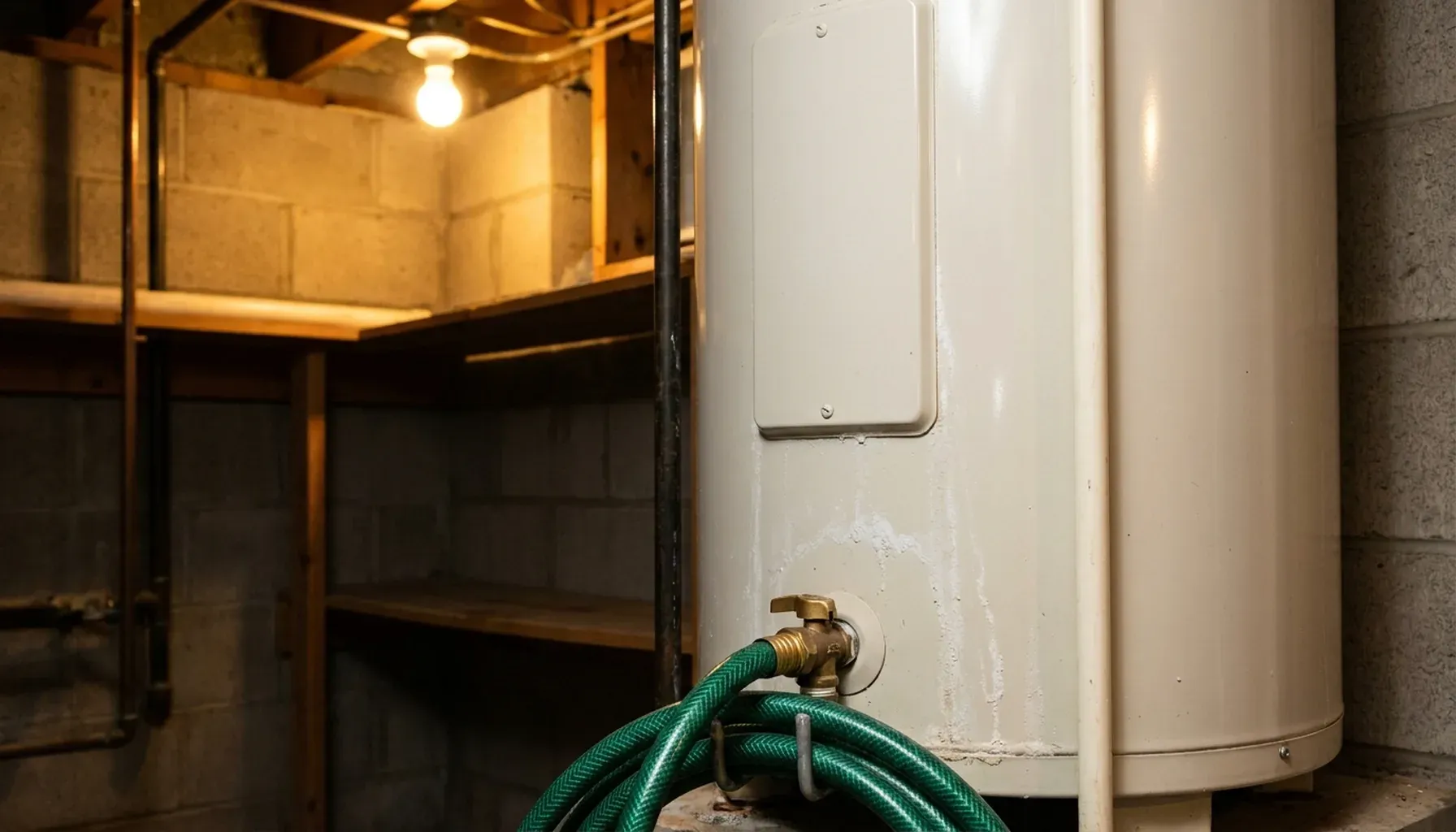
Waukegan's tap water starts in Lake Michigan, and by big-city standards it is good water. But "good" is not the same as "soft" — lake water runs moderately hard, around 8 to 9 grains per gallon, and every gallon of it that passes through your water heater leaves a little of that mineral content behind. Multiply that by the years, and hard water quietly becomes the main reason water heaters in this area wear out before their time.
Here is what is happening inside the tank, how to hear it coming, and the one cheap habit that buys your heater extra years.
What Scale Actually Does Inside the Tank
Calcium and magnesium stay dissolved in cold water, but heating forces them out of solution. In a tank-style heater, those minerals settle to the bottom as sediment — right on top of the surface the burner heats. That sediment layer works like a blanket between the flame and the water, and the consequences stack up:
- Longer burn times. The burner has to run longer to push heat through the sediment, which shows up on your gas or electric bill.
- An overworked tank. Trapped heat stresses the steel bottom of the tank itself. The popping and rumbling you hear from an older heater is water flashing to steam in pockets under the sediment — a sign the layer is already thick.
- Less hot water. Sediment takes up volume. A 40-gallon tank with years of buildup is not holding 40 gallons anymore, which is why showers start running cold sooner than they used to.
- A shorter life. Most tank heaters are built for roughly 8 to 12 years. Heavy scale pushes units toward the early end of that range; regular maintenance pushes them toward the late end.
Tankless units are not exempt — the same minerals coat the heat exchanger, restricting flow and efficiency until the unit is descaled.
The Sounds and Signs Worth Taking Seriously
Water heaters rarely fail without warning. In roughly the order they tend to appear:
- Popping, crackling, or rumbling during heating — the classic sediment sound.
- Slower recovery — the tank takes noticeably longer to reheat after heavy use.
- Rusty or metallic hot water (cold water runs clear) — corrosion is starting inside the tank or the anode rod is spent.
- Moisture, drips, or crusty mineral tracks around fittings or the drain valve.
- Water pooling under the unit. If the tank body itself is leaking, the heater is finished — a tank cannot be patched. Shut off the cold-water supply valve on top of the unit and call a plumber in Waukegan before it lets go entirely; a failed 40-gallon tank empties itself onto your floor, and that becomes an emergency call fast.
The One Habit That Pays for Itself: The Annual Flush
Draining sediment out of the tank once a year is the highest-value maintenance a homeowner can do on this appliance. A flush pulls the loose sediment out through the drain valve before it compacts into the hardened layer that causes the damage above. Done annually with Waukegan's moderate hardness, it keeps burn times short, protects the tank bottom, and preserves the tank's real capacity.
While you are at it — or better, while a plumber is — two more items are worth a look on the same visit:
- The anode rod. This sacrificial metal rod corrodes so the tank does not. It is consumed over several years and, once gone, the tank starts corroding instead. Replacing a spent anode rod is a fraction of the cost of replacing the heater.
- The temperature and pressure relief valve. It is the tank's safety valve, and it should be tested periodically to make sure it opens.
If your heater has never been flushed and it is already several years old, ask a plumber before doing it yourself — on a heavily scaled tank, an aggressive first flush can occasionally disturb sediment that was sealing a weak spot. A water heater service visit can assess the unit's condition and do the flush safely.
Repair or Replace? A Simple Rule of Thumb
- Under ~8 years old, problem is a part (thermostat, heating element, gas valve, pilot assembly): repair usually wins.
- Tank body leaking, any age: replace. There is no repair for a corroded-through tank.
- Past ~10 years with any recurring problem: put the money toward a new unit — you would be repairing an appliance already at the end of its design life, in water that works it hard.
Either way, the decision gets easier with a professional's eyes on the unit. If your water heater is making noise, running short, or showing rust, have it looked at on your schedule — March is a much better month to handle a water heater than whatever cold morning it finally picks for you.
Need a plumber?
Frequently Asked Questions
Is Waukegan water hard or soft?
Waukegan draws its drinking water from Lake Michigan, which is moderately hard - typically around 8 to 9 grains per gallon. That is softer than the well water in some outlying parts of Lake County, but still hard enough to leave scale in water heaters, on fixtures, and inside pipes over time.
How does hard water damage a water heater?
Dissolved calcium and magnesium come out of solution when water is heated and settle as sediment on the bottom of the tank. That layer insulates the burner from the water, forcing longer run times, raising gas or electric bills, and overheating the steel tank itself. In tankless units, the same scale coats the heat exchanger and restricts flow.
How often should I flush my water heater in Waukegan?
Once a year is the standard recommendation with moderately hard water like Waukegan's. An annual flush drains the sediment before it hardens into a thick layer, keeps recovery times fast, and is the single cheapest thing you can do to extend the tank's life.
What are the signs my water heater is failing?
Popping or rumbling sounds from the tank, rusty or metallic-tasting hot water, hot water that runs out faster than it used to, moisture or drips around the base, and age past the 8-to-12-year range. A tank leaking from the body of the unit - not a fitting - is done, and it is worth replacing before it fails completely.
Should I repair or replace my water heater?
As a rule of thumb - if the unit is under 8 years old and the problem is a component (thermostat, element, valve, pilot assembly), repair usually makes sense. If the tank itself is leaking, or the unit is past 10 years and having problems, replacement is normally the better money. A plumber can tell you which side of the line you are on after an inspection.