
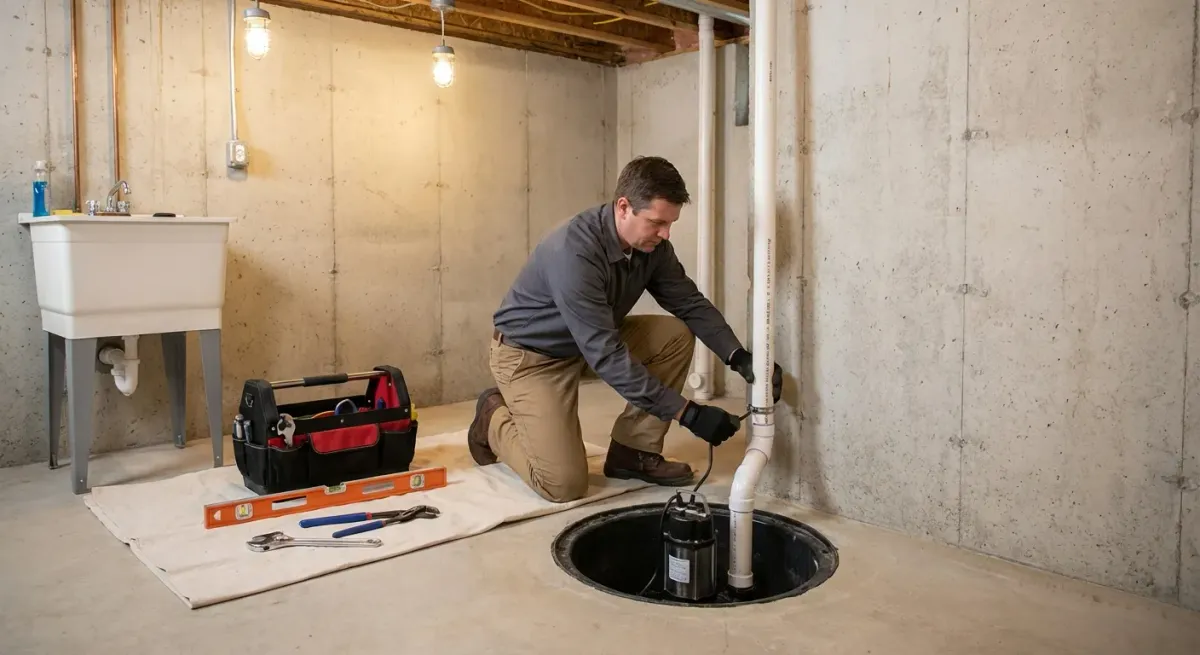
Lake County's Trusted Sump Pump Repair & Installation Experts
A sump pump is the last line of defense between your basement and a flood. When it fails — and they do fail, usually at the worst possible time — the damage adds up fast. Waukegan Plumber Pros repairs and installs sump pumps for homeowners throughout Waukegan, Gurnee, North Chicago, Beach Park, Zion, Park City, and the surrounding Lake County area.
Waukegan sits near Lake Michigan in an area with a naturally high water table. Many homes here, especially those in lower-lying neighborhoods and near the lakefront, rely on sump pumps running year-round to keep basements dry. Spring snowmelt and heavy rain events push groundwater levels even higher, and that is exactly when a worn-out pump or a failed float switch causes a basement flood. If your pump fails during a storm and your basement is taking on water, do not hesitate to call our emergency plumber line — we handle after-hours sump pump failures.
We service all sump pump types: pedestal pumps, submersible pumps, and battery backup systems. Common repairs include replacing burned-out motors, stuck or corroded float switches, failed check valves, and clogged discharge lines. If your pump is cycling constantly, running but not removing water, or making unusual noises, these are signs of a problem that will get worse without attention.
For new installations, we size the pump to your home's actual water intrusion rate — not a generic recommendation. We also install battery backup sump pumps so your basement stays dry during the power outages that often accompany the heavy storms that cause the most water intrusion.
Call (847) 750-4509 to schedule a sump pump inspection or repair.
Common Signs Your Sump Pump Needs Service
- Pump runs constantly or cycles on and off rapidly
- Pump runs but water level in the pit does not drop
- Unusual vibration or grinding noises during operation
- Pump does not turn on when the pit fills with water
- Visible rust or corrosion on the pump or discharge pipe
- Water in the basement despite the pump appearing to run
- Pump is more than 7-10 years old and has never been serviced
- No battery backup and you lose power during storms
Types of Sump Pumps
Choosing the right sump pump depends on your home's water intrusion volume, the depth of your sump pit, and how much protection you want during power outages. Here is a practical comparison of the three main types.
Pedestal Sump Pumps
A pedestal pump sits on a post above the sump pit with only the intake pipe extending into the water. The motor stays above the waterline, which makes it easier to access for maintenance and repair. Pedestal pumps tend to be less expensive upfront and can last longer than submersible models because the motor stays dry. The trade-off is noise — they are noticeably louder during operation. Pedestal pumps also require a pit that is narrow enough to accommodate the post design. For homes in Gurnee and Park City with moderate water intrusion, a pedestal pump may be sufficient.
Submersible Sump Pumps
A submersible pump sits entirely inside the sump pit, submerged in water during operation. The sealed motor housing keeps water out, and the design is significantly quieter than a pedestal unit. Submersible pumps generally move more water per minute and handle heavier groundwater loads, making them the better choice for homes in low-lying areas of Waukegan and North Chicago where the water table is high. They cost more upfront and the sealed motor is harder to service, but for serious water management they are the more reliable option.
Battery Backup Sump Pumps
A battery backup is not a replacement for your primary pump — it is a secondary system that kicks in when the power goes out or the primary pump fails. Battery backup units use a deep-cycle marine battery or a maintenance-free battery to power a separate pump. In Lake County, where severe storms regularly knock out power, a battery backup is one of the best investments you can make for basement protection. A good battery backup provides 6 to 12 hours of intermittent pumping, which is usually enough to ride out a storm. We strongly recommend a battery backup for any home that relies on a sump pump, especially in flood-prone areas of Waukegan, Beach Park, and Zion.
Sump Pump Maintenance Checklist
Regular maintenance extends the life of your sump pump and catches problems before they turn into a flooded basement. Here is what homeowners can do themselves and when it makes sense to call a professional.
Homeowner maintenance (every 3-4 months):
- Pour a bucket of water into the sump pit slowly to verify the pump turns on, runs, and shuts off properly
- Check the discharge line outside your home — make sure it is not blocked by dirt, ice, or debris
- Listen for unusual sounds during the pump cycle (grinding, rattling, or humming without pumping)
- Verify the power cord is plugged in securely and the outlet has power (easy to overlook, common cause of "failure")
- If you have a battery backup, check the battery charge indicator light
Annual professional inspection (schedule before spring):
- Clean the sump pit of gravel, sediment, and debris that accumulates over the year
- Test and clean the float switch — this is the most common failure point
- Inspect the check valve for proper operation (prevents water from flowing back into the pit after the pump shuts off)
- Verify the discharge line has proper pitch and no developing obstructions
- Load-test the battery backup under simulated power outage conditions
- Measure pump flow rate and compare to the manufacturer's specification — a significant drop means the impeller or motor is wearing out
If your sump pump shows signs of trouble between scheduled maintenance, do not wait. A pump that is making new noises, cycling more frequently than usual, or taking longer to empty the pit is telling you something. Homeowners across Waukegan, Gurnee, North Chicago, and the rest of Lake County can call (847) 750-4509 for a prompt inspection.
Also worth noting: if your basement has bathroom plumbing — a toilet, shower, or laundry hookup — a sump pump failure can compound the damage significantly. Keeping the pump in good working order protects more than just the concrete floor.
FAQ
How much does sump pump repair cost in Waukegan?
Sump pump repair typically starts at $149. Common fixes like float switch or check valve replacement are on the lower end. Motor replacement or full pump replacement costs more depending on the pump type and capacity needed.
How long do sump pumps last?
Most sump pumps last 7 to 10 years with regular use. Pumps in high-water-table areas like parts of Waukegan and Beach Park work harder and may need replacement sooner. Annual inspection helps catch wear before it becomes a failure.
Do I need a battery backup sump pump?
If your area loses power during storms — which is when your sump pump is needed most — a battery backup is strongly recommended. It provides several hours of pumping capacity during outages, which is often the difference between a dry basement and a flooded one. In Lake County, storm-related power outages are common enough that we consider a battery backup essential rather than optional.
How often should a sump pump be inspected?
We recommend annual inspection before the spring thaw and heavy rain season. The inspection covers the float switch, check valve, discharge line, pit condition, and battery backup charge level if applicable.
What size sump pump do I need?
Sizing depends on the volume of water your home deals with and the vertical distance the pump needs to push water (called the head height). Most residential sump pumps are rated between 1/3 and 1/2 horsepower. A 1/3 HP pump handles typical water intrusion in Waukegan neighborhoods with moderate groundwater. Homes in lower areas near the lake or in flood-prone sections of Zion and Beach Park may need 1/2 HP or higher. Oversizing is not always better — a pump that is too powerful for your pit will short-cycle and wear out faster. We measure your actual conditions and recommend the right size.
Can I install a sump pump myself?
Technically, yes — there is no law preventing a homeowner from installing their own sump pump. However, a sump pump installation involves cutting a pit in the basement floor (if there is not one already), running a discharge line through the foundation wall, ensuring proper check valve placement, and connecting the electrical supply. If the discharge line is not routed correctly or the pit is not sized properly, the pump will not perform as expected. Given that the cost of a failed sump pump is a flooded basement, most homeowners in Lake County find the professional installation cost is worthwhile insurance.
What happens if my sump pump fails during a power outage?
Without a battery backup, your sump pump simply stops running when the power goes out. If groundwater continues to rise — which it almost certainly will during the storm that caused the outage — your basement floods. A battery backup sump pump solves this problem by running on stored battery power for several hours. Some homeowners opt for a whole-house generator instead, which powers everything including the sump pump. If you already have a battery backup, test it annually to make sure the battery holds a charge. Batteries typically last 3 to 5 years before needing replacement.
Should I get a water-powered backup sump pump?
Water-powered backup pumps use municipal water pressure to create suction and pump out groundwater — no electricity or batteries needed. They are appealing because they never run out of charge. The downside is efficiency: they use about one gallon of municipal water for every two gallons they pump out, which increases your water bill during extended use. They also require adequate municipal water pressure (typically 40 PSI or more) to function effectively. In Waukegan and most of Lake County, water pressure is generally sufficient. A water-powered backup is a good option as a third layer of protection alongside a primary pump and a battery backup, but we would not recommend it as your only backup due to the lower pumping capacity compared to battery-powered units.
Need Sump Pump Repair & Installation?